 ultimate-guide
The Beginner's Guide to AAFCO Labeling Requirements
Last Updated: October 27, 2026
Quick Summary
Federal law requires livestock feed and pet food labels to conform to 21 CFR 501, and it is recommended that labeling also follow the Association of American Feed Control Officials (AAFCO) labeling guidelines. The FDA does not review labeling independent of new ingredient review, but many States do require label review and ingredient/product registration prior to marketing.
Labeling requirements apply to all ingredients and products, not just new ones.
- Federal law requires livestock feed and pet food labels to conform to 21 CFR 501, with AAFCO guidelines adding more detail.
- The label covers statement of identity, net quantity, ingredient statement, guaranteed analysis, nutritional adequacy, feeding directions, and business name and place.
- Structure-function claims and health claims are regulated as drugs, not food, and complete and balanced claims require substantiation on file before printing.
Table of Contents
- The Beginner’s Guide to AAFCO Labeling Requirements
- What AAFCO Covers and Why It Matters
- Core Required Elements for Commercial Livestock Feed Labels
- Pet Food and Specialty Pet Food Labeling
- Recent Pet Food Label Modernization
- Practical Tips for Feed Producers
- Claims
- Frequently Asked Questions
The Beginner’s Guide to AAFCO Labeling Requirements
Federal law requires livestock feed and pet food labels to conform to 21 CFR 501, and it is recommended that labeling also follow the Association of American Feed Control Officials (AAFCO) labeling guidelines. To check the underlying regulations yourself, visit our regulations resources page.
For animal feed and pet food producers, accurate labeling is not optional—it is a core requirement that protects animal health, enables informed purchasing decisions, and keeps products in interstate commerce. The Association of American Feed Control Officials (AAFCO) develops the model regulations that most States adopt or adapt. While AAFCO itself has no enforcement authority, its Model Bill and Regulations form the practical national standard for commercial feed and pet food labels. Understanding the basics is essential for any producer bringing products to market.
What AAFCO Covers and Why It Matters
AAFCO’s models address commercial feeds (including livestock, poultry, and specialty feeds) and the more detailed requirements unique to pet food and specialty pet food. Pet food is a subset of animal feed, so general feed rules apply, with additional pet-specific provisions layered on top. Federal FDA requirements also apply to products moving across state lines, but they are generally less detailed than the AAFCO models. Most multi-state products therefore follow AAFCO closely to achieve broad compliance. Individual states may add or modify requirements, so producers should always check with the relevant state feed control officials before distribution.

Core Required Elements for Commercial Livestock Feed Labels
For non-medicated commercial feeds, AAFCO Model Regulation 3 generally requires the following information, typically presented in a consistent order:
- Product name and brand name (if any). The name must be appropriate for the intended use and not misleading. It cannot imply characteristics the feed does not deliver.
- Purpose statement identifying the specific species and animal class(es) for which the feed is intended (for example, “Swine Grower” or “Lactating Dairy Cattle”). This may be omitted if the product name already clearly identifies the purpose.
- Guaranteed analysis showing minimums or maximums for key nutrients (crude protein, crude fat, crude fiber, and others depending on species and class). Guarantees are stated on an “as is” basis and follow a preferred sequence when multiple nutrients are listed.
- Ingredient statement listing ingredients in descending order of predominance by weight, using AAFCO-defined names or common/usual names. Defined “collective terms” (such as “grain products”) are permitted for many livestock feeds.
- Directions for safe and effective use (feeding or mixing directions) plus any required precautionary statements.
- Name and address of the manufacturer or distributor (the guarantor).
- Net quantity statement in both avoirdupois and metric units.
Single-ingredient feeds and customer-formula feeds have slightly tailored requirements, but the goal remains the same: give the purchaser clear information for safe, effective use.
Schedule a Free 30-minute Consultation →
Pet Food and Specialty Pet Food Labeling
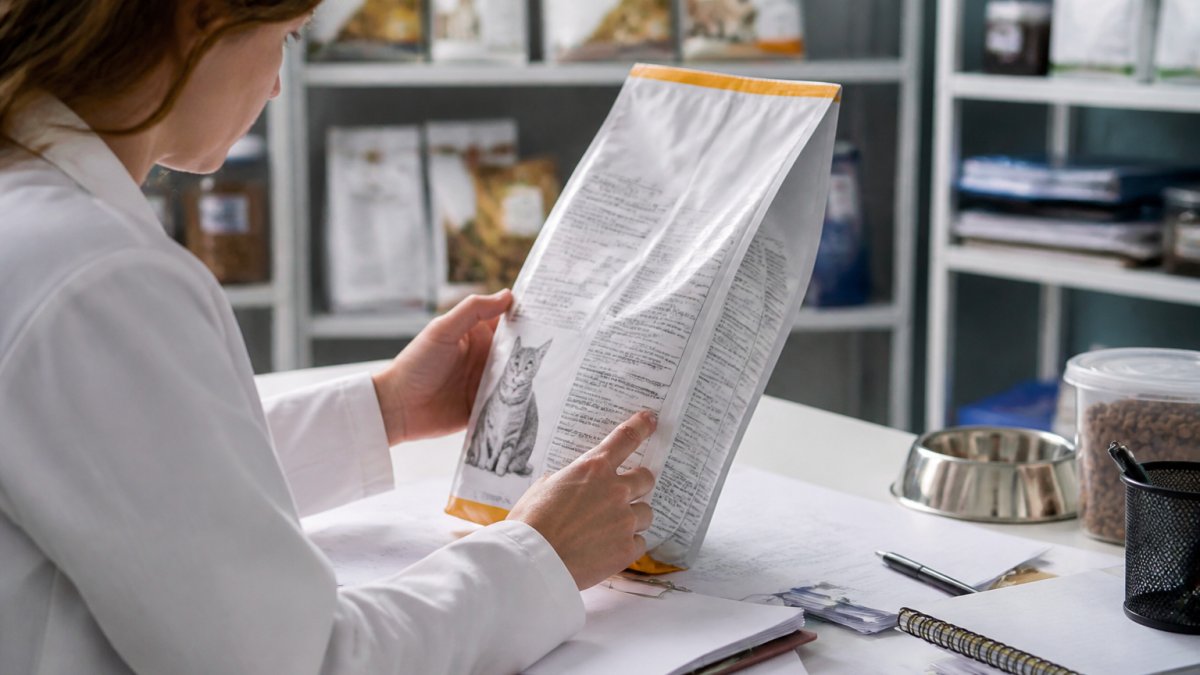
Pet food labels share many of the above elements but include additional mandatory items. Required information typically includes:
- Product and brand name, with species clearly identified on the principal display panel.
- Net quantity statement.
- Guaranteed analysis (minimum crude protein and crude fat; maximum moisture and crude fiber, plus any claimed nutrients).
- Ingredient list in descending order by weight (collective terms are not allowed on pet food).
- Nutritional adequacy statement indicating whether the product is complete and balanced for a specific life stage (growth, maintenance, gestation/lactation, or all life stages) and how that claim was substantiated (formulation to AAFCO nutrient profiles, feeding trials using AAFCO procedures, or family product equivalence).
- Feeding directions (required for most complete-and-balanced products).
- Calorie content statement.
- Name and address of the manufacturer or distributor.
Treats, snacks, and certain supplements have exemptions or modified requirements, provided they are clearly identified as such.
Recent Pet Food Label Modernization
In 2023 AAFCO approved significant updates to the Model Pet Food and Specialty Pet Food Regulations—the first major overhaul in decades—published in the 2024 Official Publication. Key changes include:
- A standardized Pet Nutrition Facts box that more closely resembles human food labeling, incorporating calorie content, key nutrient guarantees (including total carbohydrates and dietary fiber in place of or alongside crude fiber), and the nutritional adequacy statement.
- More prominent intended-use / purpose statements (including clear “Complete” language where applicable) placed in the lower third of the principal display panel.
- Clarified ingredient naming conventions, including greater use of common or usual names and parentheticals for vitamins and minerals.
- Optional standardized handling and storage instructions.
AAFCO recommended a multi-year transition period (generally described as six years from the 2024 Official Publication) during which states are encouraged to exercise enforcement discretion while manufacturers update packaging. Producers should track state adoption closely, as timelines and interpretation can vary.
The AAFCO Pet Food Label Modernization resource explains how the model label format is changing. Read our Pet Food Label Modernization article to go deeper into what that modernization means for labels.
Practical Tips for Feed Producers
Guarantees must be truthful and supportable. Ingredient names must match AAFCO definitions or approved common names. Claims (including nutritional adequacy) require proper substantiation. Medicated feeds carry additional FDA and AAFCO requirements beyond the scope of this overview. Labels that are false or misleading in any particular risk being deemed misbranded under both state and federal law.
Because the full, current details reside in the AAFCO Official Publication and state regulations, and because interpretation questions frequently arise, many producers benefit from expert review before finalizing artwork or launching distribution.
Accurate labeling builds trust with customers, regulators, and the broader supply chain. Getting the fundamentals right from the start reduces costly relabeling, delays, and compliance risk. For producers navigating AAFCO model requirements, state variations, or the ongoing pet food label modernization transition, specialized regulatory support can help ensure labels meet current standards efficiently.
This article provides a high-level educational overview based on publicly available information about AAFCO model regulations and is not legal advice. Always consult the current AAFCO Official Publication, applicable state feed laws, and qualified regulatory counsel for specific products.
Claims
The intended use and claims made by an ingredient or formulated product are used for regulatory classification. For animals, the options are only food or drug. There are no dietary supplements for animals. Generally speaking, your claims need to be related to food and nutrition, not treatment or prevention of any disease. Claims are often a point of regulatory contention of marketed products.
Schedule a Free 30-minute Consultation →
Frequently Asked Questions
Does AAFCO approve pet food labels or products?
No. AAFCO is a membership association that develops model regulations and ingredient definitions; it does not approve labels or products. States can adopt AAFCO Model Regulations into State law. Many individual States require label review and acceptance prior to marketing.
Do AAFCO labeling requirements apply to existing products as well as new products?
Yes. Labeling requirements are not restricted to new products; they apply to all ingredients and products already on the market.
What claims can be made on pet food labels?
Pet food label claims must be truthful and substantiated. Be aware that structure-function claims and health claims are regulated as drugs, not food. Speak to a regulatory professional for help revising product claims.
Your next label review does not have to be a guessing game. Seven Hills Regulatory Services, LLC brings animal scientists, animal nutritionists, toxicologists, and former FDA scientists to labeling and claims review, pre-filing consultation, and regulatory strategy, so the label you submit holds up. Get started with Seven Hills Regulatory Services, LLC and schedule a free 30-minute consultation to put your labeling and claims on firm regulatory ground.