 how-to
Pet Food Label Modernization
Last Updated: October 26, 2026
Quick Summary
Pet Food Label Modernization (PFLM) initiative began in 2015 and is the AAFCO-led rewrite of the model regulations governing what appears on a pet food label. The stated goal is “to provide consumers and regulators with labeling information that is transparent, easy to understand, and in a format more familiar to consumers”.
The pet food label moves from a decades-old format to one mirroring human food labeling conventions that States can adopt into State law. A summary of changes follow.
- PFLM applies to both pet food and specialty pet food and aligns labels more closely with human food labeling.
- PFLM would require prominently displayed intended use statement identifying species, life stage and size (by body weight).
- PFLM would require a Nutrition Facts Box to more closely resemble human food labeling. Calorie declaration, Total Carbohydrates, and Dietary Fiber are required.
- PFLM updates requirements and limitations for listing ingredients in the Ingredients Statement.
- PFLM also introduces optional standardized icons to denote handling and storage.
- Remember that model regulations carry no legal force until a State adopts them.
Table of Contents
- Pet Food Label Modernization (PFLM): What the Pet Food and Livestock Feed Industries Need to Know
- Background and Objectives
- Key Label Changes
- Timeline and Implementation
- Implications for Industry Stakeholders
- Relationship with FDA Oversight
- Recommended Next Steps
- Primary resources
- Frequently Asked Questions
Pet Food Label Modernization (PFLM): What the Pet Food and Livestock Feed Industries Need to Know
The Association of American Feed Control Officials (AAFCO) Pet Food Label Modernization (PFLM) represents the most significant update to U.S. pet food labeling model regulations in more than 40 years. Initiated in 2015 and published in the 2024 AAFCO Official Publication, the new model regulations aim to make labels more transparent, consistent, and familiar to consumers by aligning them more closely with human food labeling formats. For manufacturers, distributors, and regulators in the pet food and livestock feed sectors, understanding these changes is essential for compliance planning, product reformulation, packaging redesign, and state-level registration strategies. While AAFCO develops the model language, individual states adopt and enforce the rules, and the U.S. Food and Drug Administration (FDA) continues to oversee federal safety, manufacturing, and basic labeling requirements under the Federal Food, Drug, and Cosmetic Act.
Background and Objectives
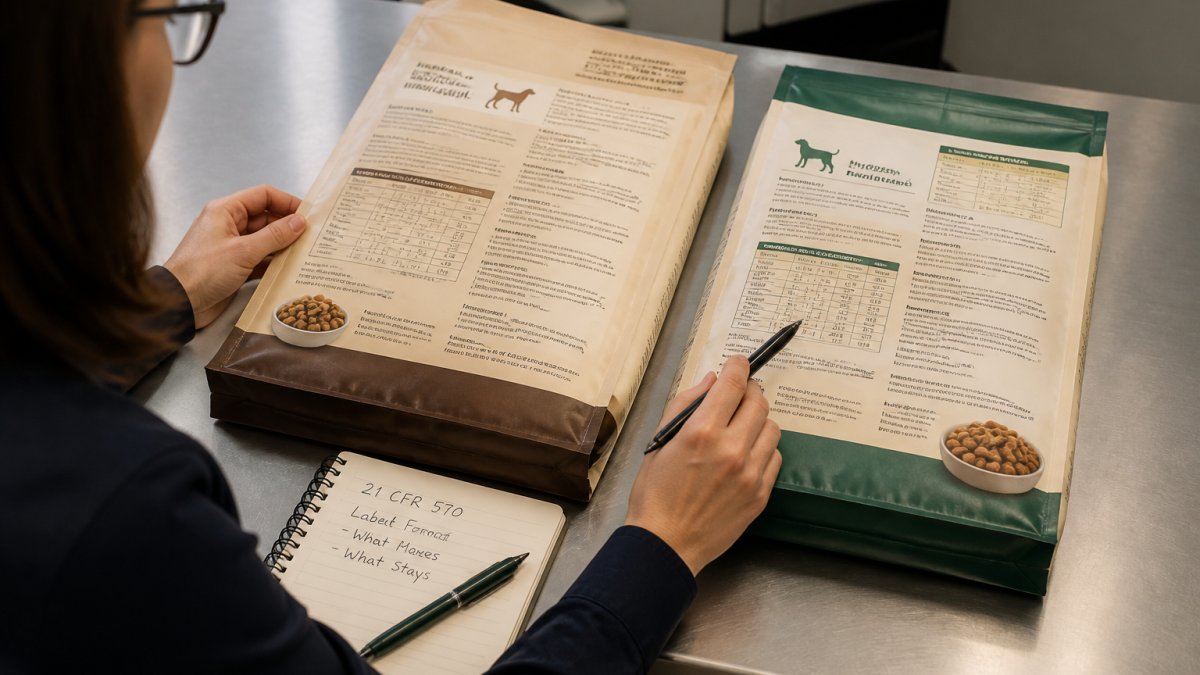
AAFCO launched PFLM to address longstanding consumer and regulatory feedback that traditional pet food labels were difficult to interpret. The project involved multiple rounds of consumer research, workgroups with regulators and industry advisors, and public comment periods. For background on how that committee process works, see our guide to navigating AAFCO meetings. The resulting model regulations for Pet Food and Specialty Pet Food became effective January 1, 2024.
The primary goals are:
- Greater transparency and ease of understanding for pet owners
- More consistent presentation of nutritional information
- Clearer communication of intended use and nutritional adequacy
- Alignment with formats consumers already recognize from human food packages
Specialty pet foods (e.g., for birds, fish, reptiles, and other non-dog/cat species) are also covered under the updated framework.
Key Label Changes
The most visible updates include:
1. Pet Nutrition Facts Box
This replaces the traditional Guaranteed Analysis panel and is modeled on the human Nutrition Facts label. It typically includes:
- Calories per common household unit (cup, can, pouch, treat, etc.)
- Calorie contribution breakdown from protein, fat, and carbohydrate
- Nutrient guarantees expressed both as percentages (as-fed) and in household measures
- Total carbohydrate (calculated maximum) and dietary fiber (maximum), replacing the previous crude fiber guarantee
- The nutritional adequacy / intended use statement integrated into or directly associated with the box
2. Purpose / Intended Use Statement on the Principal Display Panel
A clear statement identifying the species and the product’s intended purpose or life stage must appear prominently on the front of the package. This helps consumers quickly determine suitability (e.g., adult maintenance, growth, all life stages, intermittent or supplemental feeding).
3. Nutritional Adequacy Statement
The familiar AAFCO nutritional adequacy language remains but is now positioned in conjunction with the Pet Nutrition Facts box for easier reference.
4. Ingredient Statement Updates
Clarifications address the use of parentheticals and common or usual names (particularly for vitamins and certain ingredients) to improve consistency and reduce consumer confusion. New ingredients still need to clear the appropriate safety pathway before they can appear on a label; see our guide to the GRAS notification process for ingredients for details.
5. Handling and Storage Instructions
Standardized language and optional icons promote more uniform presentation of storage and handling guidance.
6. Substantiation for Certain Claims
Health and benefit claims (e.g., joint support, coat condition, digestive health) face clearer expectations for finished-product testing or feeding trial data. These requirements apply across complete and balanced foods, treats, mixers, supplements, and veterinary diets. No major product category is exempt. Claims that stray into disease prevention or treatment territory also carry risk for reclassification as a drug; see our guide to avoiding FDA product reclassification.
Timeline and Implementation
AAFCO recommends a six-year transition (enforcement discretion) period following publication in the 2024 Official Publication. Full industry alignment is generally expected by the end of 2030, though exact dates depend on each state’s adoption and enforcement policy.
Important practical points:
- Hybrid labels that mix old and new model requirements are not acceptable.
- Legacy (pre-PFLM) labels remain acceptable in many states during the discretion window.
- Some states (for example, Washington) have publicly aligned their enforcement delay with the 2030 timeframe.
- Manufacturers should monitor individual state feed control programs, as timelines and registration implications can vary.
Recent AAFCO guidance has also aligned certain nutritional profile updates (such as revised feline calcium and phosphorus profiles) with the same PFLM enforcement-discretion window to avoid creating separate compliance tracks.
Implications for Industry Stakeholders
Pet food manufacturers must plan for new laboratory analyses (especially dietary fiber and calorie contribution data), packaging redesign, artwork updates, and potential formula adjustments. Early testing and label development reduce risk of last-minute disruptions and better position brands for retailer expectations. Many manufacturers bring in outside regulatory support for this stage; see our guide to expert pet food regulatory help for what that can look like.
Livestock feed and specialty pet food producers should evaluate whether their products fall under the updated model regulations and prepare accordingly, particularly for any dual-use or specialty lines.
Regulators and quality teams benefit from consistent model language that supports interstate commerce while still allowing state-specific adoption.
Retailers and distributors will encounter both legacy and modernized labels on shelves for several years and may need updated staff training and consumer communication materials.
Schedule a Free 30-minute Consultation →
Relationship with FDA Oversight
FDA continues to enforce federal requirements that pet food be safe, produced under sanitary conditions, free of harmful substances, and truthfully labeled. For a broader look at how these federal rules apply to animal food generally, see our guide to navigating FDA animal food regulations. AAFCO model regulations do not replace federal law; they provide the detailed labeling framework that most states incorporate. FDA participates in AAFCO committees and provides scientific input, but day-to-day label enforcement for the new format primarily occurs at the State level once adopted.
Recommended Next Steps
- Review the current AAFCO Official Publication and PFLM resources on aafco.org/pflm.
- Conduct a gap analysis of existing labels and formulas against the new requirements.
- Engage laboratories early for the additional analytical data needed for the Pet Nutrition Facts box.
- Coordinate packaging and regulatory teams on a state-by-state adoption and registration plan.
- Monitor ongoing AAFCO guidance and individual state policy statements through 2030.
The Pet Food Label Modernization project ultimately aims to strengthen consumer trust through clearer communication while giving the industry a standardized, modern framework. Companies that begin the transition process now will be best positioned for a smooth path to full compliance.
Primary resources
- AAFCO Pet Food Label Modernization: https://aafco.org/pflm
- FDA Pet Food information: https://www.fda.gov/animal-veterinary/animal-foods-feeds/pet-food
This overview is intended for industry professionals and should be supplemented with the official AAFCO model regulations, current Official Publication, and advice from qualified regulatory counsel or state feed control officials for specific product decisions.
Frequently Asked Questions
What is Pet Food Label Modernization?
Pet Food Label Modernization (PFLM) is AAFCO's rewrite of the model regulations that govern how pet food and specialty pet food labels present product identity, ingredient statements, guaranteed analysis, and nutritional adequacy. The goal is clearer consumer-facing information and closer alignment with human food labeling conventions. States can adopt AAFCO Model Regulations into State law, so PFLM reaches your packaging through State adoption. Review the current project materials at aafco.org/pflm before you redesign anything.
When will the new pet food labeling requirements take effect?
The Association of American Feed Control Officials’ (AAFCO) published these model regulations in the 2024 Official Publication (OP). There is a recommended 6 year implementation phase. The model regulation must be adopted into State law, and each State sets its own timeline and any transition period for existing inventory.
How should manufacturers prepare for the new AAFCO model regulations?
Start with a full audit of every active SKU against the revised model regulations, then work through a pet food label compliance checklist: product identity, ingredient statement, guaranteed analysis, nutritional adequacy statement, feeding directions, net quantity, and claims. Flag anything that needs a formula or supplier change, because those take longer than artwork edits. Then map each SKU to the States where it sells and build the redesign around the earliest adoption date you face.