 ultimate-guide
What Are the FDA Animal Food Labeling Requirements?
Last Updated: October 28, 2026
Quick Summary
Animal food labeling must comply with the Federal Food, Drug, and Cosmetic Act and 21 CFR 501, which is not as extensive at the AAFCO Labeling Guidelines.
- Federal Framework
- Labeling Requirements
- Veterinary Medical Diets
- Claims & Miscellaneous
Table of Contents
- FDA Animal Food Labeling Requirements: A Guide for Animal Feed and Pet Food Manufacturers
- Federal Framework: 21 CFR Part 501 and Core Labeling Mandates
- Labeling Requirements for Animal Feed (Livestock and Production Animals)
- Pet Food Labeling: Federal Baseline Plus AAFCO Model Requirements
- Veterinary Medical Diets and Therapeutic Claims
- Claims, Ingredient Status, and Common Compliance Pitfalls
- Best Practices for Manufacturers and the Path Forward
- Frequently Asked Questions
FDA Animal Food Labeling Requirements: A Guide for Animal Feed and Pet Food Manufacturers
Accurate labeling is a cornerstone of compliance for animal feed and pet food manufacturers. The U.S. Food and Drug Administration (FDA), primarily through its Center for Veterinary Medicine (CVM), regulates animal food under the Federal Food, Drug, and Cosmetic Act (FD&C Act). Labels must ensure products are safe, properly identified, and not misleading, while also meeting practical needs for safe and effective use. Non-compliance can result in misbranding, adulteration findings, product seizures, or enforcement actions.
This guide covers federal requirements under 21 CFR Part 501, the interplay with Association of American Feed Control Officials (AAFCO) model regulations and State laws, distinctions for animal feed (livestock and other production animals), pet food, and veterinary medical diets (therapeutic or disease-intended complete diets). It is written for manufacturers navigating labeling for interstate commerce and State distribution.
For additional insight in how these rules apply in practice, see our labeling resource page.
Schedule a Free 30-minute Consultation →
Federal Framework: 21 CFR Part 501 and Core Labeling Mandates
Animal food includes pet food, livestock feed, ingredients, and related products intended for animal consumption. Section 201(m) of the FD&C Act defines “labeling” broadly to encompass labels on containers or wrappers plus accompanying materials such as brochures, websites, or promotional sheets.
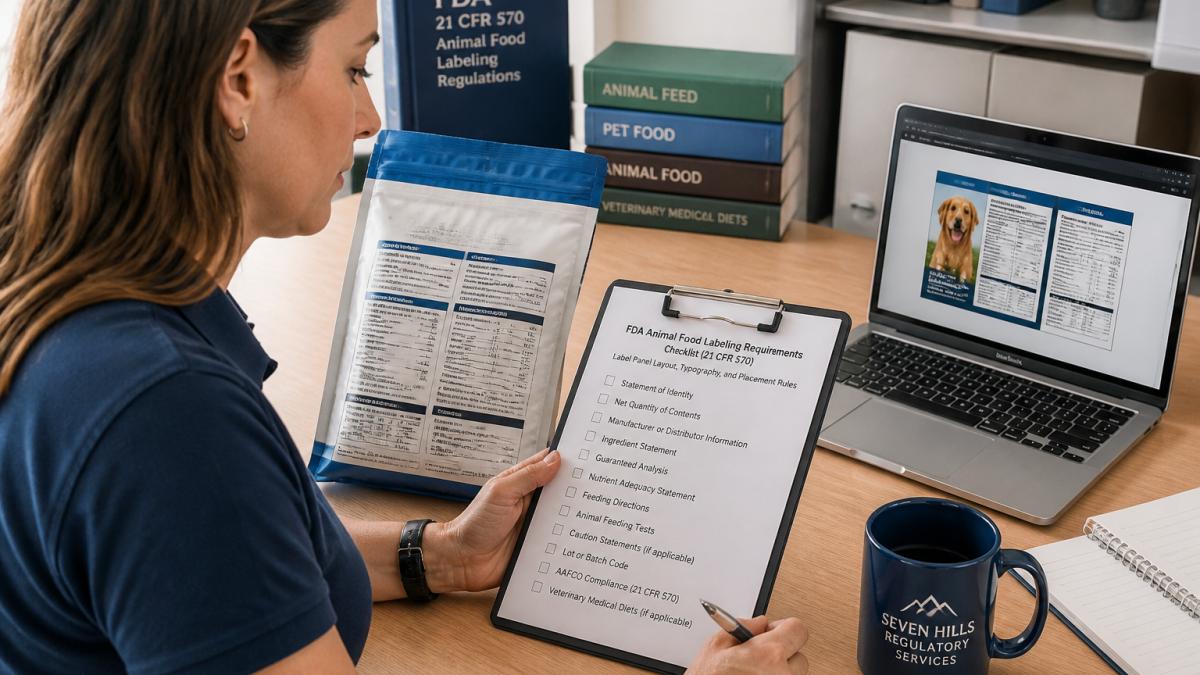
The primary federal regulations appear in 21 CFR Part 501. Required elements generally include:
- Proper identification of the product (statement of identity).
- Net quantity of contents statement.
- Name and place of business of the manufacturer, packer, or distributor.
Listing of all ingredients by common or usual name in descending order of predominance by weight.
The principal display panel (the part most likely to be seen at retail) must feature the statement of identity and net quantity. The information panel carries additional details. Ingredients must use common or usual names; AAFCO-defined ingredient names are generally acceptable under FDA enforcement policy. Collective names (e.g., animal protein products, grain products) are permitted for certain feed ingredients under specified conditions in 21 CFR 501.110.
Additional rules address spices, flavorings, colorings, and chemical preservatives (21 CFR 501.22). Certified color additives must be declared appropriately. Warning statements apply in limited cases, such as self-pressurized containers. Labels must be in English (with translation requirements if other languages appear). Misbranding occurs if required information is missing, false, or not prominent and conspicuous enough for ordinary consumers or users under customary conditions of purchase and use.
Federal rules set a baseline. Animal food products are also subject to individual State laws. Many States adopt or reference AAFCO’s Model Regulations for animal food and the more detailed Model Regulations for Pet Food and Specialty Pet Food. Manufacturers distributing across State lines must satisfy both federal requirements and the laws of each destination State. AAFCO’s Official Publication provides the model language and is updated periodically. For a additional information see The Beginner's Guide to AAFCO Labeling Requirements.
Labeling Requirements for Animal Feed (Livestock and Production Animals)
Animal feed for livestock, poultry, aquaculture, and other production animals follows the core federal mandates in 21 CFR Part 501. Labels typically emphasize purpose statements, guaranteed analysis of key nutrients, ingredient lists, and directions for use. Medicated feeds carry additional requirements tied to the specific Type A medicated article approval, including “Blue Bird” model labels that guide final feed labeling.
Collective ingredient names are more commonly used in commercial feeds. Guaranteed analysis usually includes minimums for protein and fat and maximums for fiber and moisture, along with other nutrients relevant to the species and purpose (e.g., vitamins, minerals, or non-protein nitrogen where applicable). Purpose statements clarify intended use (e.g., complete feed for growing swine or dairy cattle). Directions for use and any caution or warning statements are critical for medicated products or those with specific handling needs.
Manufacturers must also comply with Current Good Manufacturing Practice (cGMP) for animal food, Hazard Analysis, and Risk-Based Preventive Controls for Food for Animals (21 CFR Part 507) under the Food Safety Modernization Act (FSMA). While these focus on production rather than labeling per se, labeling can support food safety (e.g., storage or use instructions). Facility registration and preventive controls plans are mandatory for most facilities manufacturing, processing, packing, or holding animal food.
State feed laws often require product registration or licensing before distribution. Guaranteed analyses and ingredient declarations must align with AAFCO definitions to facilitate interstate movement and State acceptance.
Schedule a Free 30-minute Consultation →
Pet Food Labeling: Federal Baseline Plus AAFCO Model Requirements
Pet food (primarily dog and cat food, plus specialty pet foods) is regulated similarly to other animal feed at the federal level: product identity, net quantity, manufacturer/distributor information, and complete ingredient list in descending order by weight.
States adopting AAFCO Model Pet Food Regulations impose more specific requirements that manufacturers treat as de facto standards for national distribution. Key elements typically include:
- Brand name (if any) and product name, with rules governing the use of ingredient names in the product name (e.g., percentage thresholds for “chicken,” “chicken dinner,” or “with chicken”).
- Species designation.
- Net quantity statement (weight, measure, or count, often dual English and metric).
- Guaranteed analysis: at minimum, minimum percentages of crude protein and crude fat, and maximum percentages of crude fiber and moisture (as-fed basis). Additional guarantees are required for claimed nutrients.
- Ingredient statement in descending order of predominance by weight, using common or usual names.
- Nutritional adequacy (or purpose) statement: indicates whether the product is complete and balanced for a specific life stage (growth, reproduction, adult maintenance, or all life stages) or intended only for intermittent/supplemental feeding. Substantiation occurs via formulation to meet AAFCO Dog or Cat Food Nutrient Profiles or via animal feeding tests using AAFCO procedures.
- Calorie content statement (required for dog and cat foods).
- Feeding directions (generally required for complete and balanced products).
Name and address of the manufacturer or distributor (guarantor).
Recent AAFCO Pet Food Label Modernization efforts introduce a “Pet Nutrition Facts” box (modeled loosely on human Nutrition Facts panels) that consolidates calorie information, key nutrient guarantees (including total carbohydrate and dietary fiber in updated formats), and the nutritional adequacy statement. Intended-use language such as “Complete Adult Dog Food” or similar phrasing is expected to appear prominently on the principal display panel. Implementation timelines vary by State as they adopt the updated model regulations; a multi-year transition is typical. Our Pet Food Label Modernization article covers the formatting changes coming through AAFCO's Pet Food Label Modernization initiative.
Treats, snacks, and nutritional supplements are often exempt from full nutritional adequacy statements and feeding directions but still require core identity, quantity, manufacturer, and ingredient information. Claims on labels or accompanying materials must be truthful and not misleading and should not imply treatment, prevention, or mitigation of disease.
Veterinary Medical Diets and Therapeutic Claims
Veterinary medical diets—complete pet food diets intended both to provide daily nutrition and to diagnose, cure, mitigate, treat, or prevent disease (e.g., renal, urinary, diabetic, or weight-management formulas)—occupy a special regulatory space. Under the FD&C Act, products intended to treat or prevent disease meet the definition of a drug. Most such complete diets lack new animal drug approval and would otherwise be considered unapproved (and therefore unsafe) new animal drugs.
FDA’s Compliance Policy Guide (CPG) Sec. 690.150 addresses labeling and marketing of dog and cat food diets intended for these purposes while also serving as the sole or primary diet. FDA may exercise enforcement discretion regarding drug approval requirements when certain factors are present, including:
- Availability primarily through licensed veterinarians or under veterinary direction (including certain retail/internet sales with veterinary oversight).
- No known safety risk when used as labeled.
- Absence of disease-treatment or prevention representations on the product label itself that are available to the general public (claims may be limited to veterinary professionals).
- Secure distribution of disease-related labeling and manufacturer communications primarily to veterinary professionals.
- Compliance with all applicable food labeling requirements in 21 CFR Part 501.
- Use of only GRAS ingredients, approved food additives, or AAFCO-defined ingredients (subject to current FDA policy).
Labeling that is not otherwise false or misleading.
Manufacturers should carefully separate consumer-facing labels from veterinary professional materials. Overly promotional disease claims directed at pet owners can increase regulatory risk. Substantiation of any structure/function or specific health claims (e.g., urinary tract health, hairball control) is essential; FDA has issued guidance for certain claims such as urinary pH or relative supersaturation support.
Schedule a Free 30-minute Consultation →
Claims, Ingredient Status, and Common Compliance Pitfalls
Any expressed or implied claim that a product cures, treats, prevents, or mitigates disease, or affects structure/function beyond ordinary nutritive value, aroma, or taste, can render the product a drug requiring approval. Specific claims on pet food (urinary tract health, low magnesium, hairball control) receive FDA review; supporting data should follow relevant guidance.
Ingredients must be approved food additives, GRAS for the intended use, or otherwise lawful (with FDA policy recognizing many AAFCO-defined ingredients). Unapproved additives render the food adulterated. Color additives, preservatives, and flavorings have specific declaration rules.
Common pitfalls include incomplete or out-of-order ingredient lists, inadequate prominence of required statements, unsubstantiated “complete and balanced” claims, missing calorie statements on dog/cat foods, product names that overstate ingredient content, and disease claims that convert a food into an unapproved drug. State registration failures and inconsistencies between labels and marketing materials are frequent issues. FSMA preventive controls and facility registration obligations run parallel to labeling compliance.
For the wider compliance picture, including FSMA and facility registration, see our 2026 guide to FDA animal food regulations. Additionally, the FDA's animal food guidance sets out the federal expectations for the abbreviation cGMP and sanitary conditions.
Best Practices for Manufacturers and the Path Forward
Develop labels with both federal and AAFCO/State requirements in mind from the formulation stage. Maintain documentation for nutritional adequacy substantiation, claim support, and ingredient status. Review all labeling—including websites, social media, and professional literature—for consistency. Monitor AAFCO Official Publication updates and State adoption of model regulation changes, particularly pet food modernization elements. For medicated feeds or novel ingredients, align labeling with approved applications or notifications.
Veterinary medical diets demand extra caution: design distribution channels, label content, and professional communications to align with CPG 690.150 factors. Engage regulatory experts early when claims approach the food/drug boundary or when entering new States or markets.
Seven Hills Regulatory Service, LLC specializes in regulatory consultancy for the livestock feed and pet food industries. With expertise in labeling, claims, pre-market pathways (including food additive petitions, GRAS notifications, and AAFCO processes), and compliance strategy, the firm helps manufacturers navigate FDA and State requirements efficiently. Proper labeling protects animals, supports market access, and reduces enforcement risk—partnering with experienced advisors can streamline the process from formulation through commercialization.
Manufacturers who treat labeling as an integral part of product development and quality systems are best positioned for sustained compliance and commercial success in the animal food sector. Always verify current regulations, guidance, and State requirements, as policies and model regulations evolve. Schedule a call to book a free 30-minute consultation.
Frequently Asked Questions
What information must appear on an animal food label?
Every animal food label needs a product identity or statement of identity, a net quantity of contents, an ingredient list in descending order by weight, and the name and place of business of the manufacturer, packer, or distributor. Labels must be truthful and not misleading under the FD&C Act. Federal labeling regulations are not as extensive as the AAFCO Label Guidelines.
How do FDA and AAFCO requirements for animal food labels differ?
The FDA enforces federal rules under the FD&C Act and 21 CFR 501, covering truthful labeling, ingredient declaration, net quantity, and responsible party identification. AAFCO publishes Model Regulations for livestock species and pet food. Individual States can adopt AAFCO Model Regulations into State law.
How should ingredients be listed on a pet food label?
List ingredients by their common or usual name in descending order by weight, starting with the ingredient that weighs the most. Use AAFCO Ingredient Definitions and, where relevant, the GRAS & AFIC Inventories for common names. Ingredient emphasis, such as highlighting a named ingredient in the product identity, must match the actual proportion in the formula.
What claims can animal food manufacturers make on product labels?
Labels may carry truthful, substantiated claims about the product's composition, nutritional adequacy, and intended use. Structure-function claims and health claims are regulated as drugs, not food.
How are veterinary medical diets labeled?
Veterinary medical diets are animal food but require special review and consideration for their role in treating or preventing a disease. Labeling should adhere to 21 CFR 501 as well as the AAFCO labeling guidelines.
How can a manufacturer check whether an animal food ingredient is authorized?
Check the GRAS & AFIC Inventories, and AAFCO Ingredient Definitions, as well as codified food additives under 21 CFR 573.